Showing posts with label Bulgaria. Show all posts

Monday, August 6, 2012

A Brief History of Kosovo

The Republic of Kosovo declared independence from Serbia on February 17, 2008 and has been recognized by 91 member states of the UN to date. It borders the Republic of Macedonia to the south, Albania to the west and Montenegro to the Northwest. On its north and East is Serbia, who still claims Kosovo to be part of its sovereign territory, albeit controlled by the United Nations. Further confusing the Balkans region is North Kosovo, a disputed area of Kosovo which both Kosovo and Serbia claim to be their own, but is primarily made up of Kosovar Serbs and runs like Serbia within Kosovo.

Ok to recap, we have Kosovo which is inside of Serbia and is de facto independent but still claimed by Serbia and within Kosovo is North Kosovo which is claimed by both Kosovo and Serbia but is run by Kosovar Serbs in conjuction with Serbia. Got it? Unfortunately, a brief look at this trouble filled Balkan nation doesn't offer any simpler understanding of its history.

Kosovo was occupied in its earliest times by prehistoric tribes, meaning people that didn't write their history down, not cavemen. Although, Kosovo did have a pretty cool prehistoric past. But, in the 1st century AD, the Roman Empire took over the region that would become Kosovo in the 1st Century AD and called it Moesia Superior. When the Western Roman Empire began to fall apart due to hoards of barbarians coming up against some pretty terrible rulers of the Late Western Empire a bunch of Slavic people began to migrate to the area. This was during the 6th and 7th centuries. After all this Slavic shifting the area became part of the Bulgarian Empire that arose to challenge Constantinople as a power in the region. But, the Byzantine Empire flexed their muscles and wrenched control of the region back from the Bulgarians.

The Kosovars however were not easily managed and had a penchant for bucking under Byzantine rule. They bounced back and forth allying themselves with Serbian rules and Bulgarian ones so long as they didn't have to pay homage to the Eastern Emperors. Finally this culminated in the powerful but short-lived Serbian Empire. It's patently unfair to call them short-lived but they're in roughly the same region as their contemporaries the Byzantines. Every one seems short-lived compared to them no? But, under the Serbian Empire, Kosovo became the spiritual center of the Serbian Kingdom. It was under this point in Kosovo history that the famous Battle of Kosovo pitted the Serbs against the burgeoning Ottoman Empire. The Serbs and Kosovars fought valiantly and decimated the Ottoman Army. Unfortunately the Serbs were also decimated and unlike the Ottomans did not possess massive reserves of fighting men to the east. Eventually because of the lack of manpower the Serbian Empire and thus, Kosovo would become part of the Ottoman Empire in the 15th century.

The Ottomans brought many changes, especially the Islamic faith. Ethnic Serbs clung to Christianity but their neighbors the ethnic Albanians generally converted. (This is of course an over simplification but for the sake of brevity one that must be made). This created a tinderbox effect and would have extremely long and devastating consequences. In the late 19th century and early 20th century nationalism was added to the already present religious tensions of the region. Muslim Albanians fought against the Ottoman Empire for more autonomy while many Christian Serbs wanted out. As Kosovo had both of these parties the place was on eggshells to say the least. Then, World War I broke out. Eventually out of the ashes, Yugoslavia would take over the area once owned by the now defunct Ottoman Empire.

The confusing and muddled history of Kosovo continued into the Yugoslavian days as Yugoslavia moved from monarchy to communist state. Many parts of Yugoslavia got their own their own special status as a Socialist Republic within the nation. Serbia was one of them, but Kosovo (inside the SR Serbia) got its own autonomous position as a province. This kept tensions high and as Yugoslavia began to disintegrate Serbia tried to assert its authority over much of the dying nation. Slobodan Milosevic rose to power and in basic response to this Kosovo first declared itself a separate socialist republic within Yugoslavia and then its own independent state. This led to war in the 1990's that witnessed some horrific atrocities and ethnic cleansing in the war between primarily Muslim Albanians and the Christian Serbs. For much of the 1990's Kosovo called itself the Republic of Kosova, but it was only internationally recognized by Albania. In 2000 the region became controlled by the United Nations Mission in Kosovo, the status which Serbia still recognizes it. But, The Republic of Kosovo declared its independence from both the UN and Serbia in 2008.

And that is a brief, probably far too brief, but basic understanding of where Kosovo stands in Modern European History. Unfortunately the conflict between Kosovo and Serbia seems to be still brewing under the surface. Just yesterday a story emerged that Serbia was blocking Kosovo in the neutral buffer zone because Serbia was unhappy with the commercial goods moving north out of Kosovo. It is minor incidents like these that could lead to a further escalation of the long standing crisis that could erupt into another confusing and unfortunately bloody war, rife with ethnic and religious divisions.

Saturday, August 4, 2012

Copper Mining in the Ancient Balkans

A typical example of a mineshaft.


Two of the oldest copper mines in Europe come from the Balkans. In Serbia, there is the Rudna Glava belonging to the Vinča culture who we have discussed not once, but twice here on the blog and in the podcast. The discovery of these mines have changed the way we think of the Neolithic and the Chalcolithic periods of European history by pushing back European usage of copper by a thousand years or more.


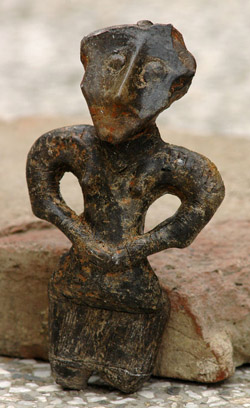
Vinča Copper Idol
Both the Prehistoric Serbians and Bulgarians dug trenches into the mountain or hillside to extract the copper by use of stone and bone or antler tools. Once they found it they broke off some of the large rocks containing the copper by heating it up and then pouring water over it to crack the rock. Then they would extract the copper and take it somewhere to smelt the copper out and make artifacts.

The Vinča were accustomed to digging their houses into the hillside and the banks of the Danube so it only makes sense that these guys would employ the same technique to extract copper. Because the Vinča had a rich social life that showed some of the early evidence of River gods and goddesses worship it seems natural that idols would be made of this new, shiny metal that they were learning to work.

Thursday, May 31, 2012

The Victorious Varna Culture

The Varna Culture existed in Bulgaria around 4400 BC - 4100 BC. It was roughly contemporaneous with other Bulgarian cultures like the Karanovo and the Lengyel which we briefly discussed on the Neolithic podcasts. The Varna however, is going to get some special treatment because they show signs of being a trendsetter in burial methodologies. Just think, 6,000 years from now you, if you are remembered at all, will be remembered for what they bury your member in. I'll explain in a second.

The two most important sites of the Varna culture are located in modern day Varna and Durankulak, Bulgaria. Both of these cities are located in the northeast of Bulgaria and are located on the coast of the Black Sea. The culture seems to have subsisted on farming, but they were also traders. Artifacts in both sites contain stuff from south in the Mediterranean like spondylus shells and flint and crafts made up north in the Volga region. The Varna made some pretty cool stuff to trade for their partners as well.

The Varna seem to have been the first to craft golden treasures. This shiny stuff made its way from Bulgaria all over eastern Europe. Their crafting of idols and elaborate burials lead us to believe that they had a pretty rich religious life and belief in the hereafter. Ok, so now on to the trendsetting of the Varna and their unique burial practices.

The Varna buried their people, or at least some of them with a whole bunch of gold. One grave at the Varna Necropolis had more gold in it than all of the other graves in the world at the time. This alone would make them a big time first in prehistory. But, they also seem to have been the first in Europe to bury an "elite" man. Prior to the Varna mostly women and children got more special treatment in burials. Some of these special tombs were placed beneath homes, indicating a special connection to their households. But, in the Varna culture, the men started to get the better posthumous treatment.

We now know that the Varna liked gold. What were about to learn is that the Varna could have served as an Austin Powers villain. The Varna have their own Goldmember. In one of the tombs found, this being of the oldest elite male burial in Europe, the deceased was buried with a whole bunch of gold, a war axe in his hand and sheath made of gold placed directly on his penis. Austin Powers would have had a handful with this precursor to the freaky-deaky Dutch Goldmember.

Marija Gimbutas, who we'll cover extensively in the next podcast of the Stone Age round up, furthers her theory on the pre Indo-Europeans and their matriarchal society with stuff like this. Basically what the Varna represent to her is the transition from a female oriented society and a male dominated one. Whether this is truly accurate or not is debatable and we'll put forth more evidence in the podcast, but it definitely marks a transition to a much more stratified society. And for this reason the Varna get our preferential treatment, which is worth a whole bunch of points you know. These points have now made them the Victorious Varna Culture (I would give them a trophy if I could).

Sunday, May 27, 2012

The Vinča culture

The Lady
The Vinča culture is also called the Turdaș-Vinča culture or simply the Turdaș culture. Whatever name you give it its hard to write it on an American English keyboard because of the silly č and ș. Part of me wants to name my first son Çḩṙîṧẗöῥḫἐṟ so that he works on his handwriting and it is better than mine. The other part of me thinks that this would be unduly cruel.

Anyway, the Vinča culture existed in Southeastern Europe from around 5500 BC - 4500 BC, specifically in modern Kosovo, Serbia, Romania, Bulgaria, Bosnia, Montenegro, Macedonia and Greece. The origins of the Vinča culture are debated. Some think that they migrated to the Balkans from Anatolia while others think they developed naturally out of the rich Starčevo–Kőrös–Criş culture and were local to the area. Either way they were a Neolithic culture that farmed, made pottery, raised livestock and supplemented it all with hunting and gathering. The Vinča are best known because of the Vinča symbols we discussed earlier.  But when they weren't making pre or proto-language they were carving fantastic figurines.

The Vinča produced a number of fascinating sculptures, including the Lady of the Vinča. This idol, that dates to around 5000 BC was found near Belgrade in 1929. It shows a sophisticated craftsmanship. If you remember the Starčevo–Kőrös–Criş culture was a rich religious culture that was fascinated with fish gods. It produced troves of fish-men statues associated with a river religion. The Vinča seems to have continued in this religious vein, but switched from river deities to a fertility cult.

When they weren't practicing religion the Vinča were busy developing the first copper tools of Europe. The Vinča site at Pločnik in Serbia unearthed the earliest copper tools in Europe when people were setting up the railroad in the 1920's. Pločnik was inhabited from around 5500 - 4700 BC until the settlement was burned to the ground. But, before the fire took the settlement the people used fire to forge some great prehistoric weaponry.

Wednesday, May 23, 2012

Sesklo - The First Neolithic Culture of Europe

The Sesklo Culture is famous for being one of the first Neolithic cultures in Europe. If you remember, a culture becomes a Neolithic one when it discovers how to do one of two things or both. It leaves the Mesolithic to join the the Neolithic when it masters farming or starts building pottery. The Sesklo seem to have done this as early as 6850 BC give or take a margin of error. They did this in what is modern day Greece in the regions of Thessaly and Macedonia. Confusingly, the culture seems to arisen out of two cultures, the Pre-Sesklo and Proto-Sesklo cultures. The distinction is so ridiculously nuanced that I can't seem to wrap my head around it, let alone explain it. But, that's where they come from.

They became Neolithic by learning how to farm wheat and barley. Because Nabisco's Wheat Thins and barley laden Rye Whiskey cannot sustain a man (trust me on this one), the Sesklo culture also kept herds of sheep, goats and a few cows and pigs. They completed the double Neolithic by fashioning bowls and cups to eat and drink out of. The Rye Whiskey though they liked to drink straight from the bottle like a boss.

The Sesklo would have been a minor footnote in history had they not influenced other cultures though. In this they seem to have been prolific. They influenced the Karanovo and the Starčevo–Kőrös–Criş in the Balkans. The Starčevo–Kőrös–Criş would then go on to influence the Danubian cultures that stretched all over Southeastern and Central Europe. The Sesklo also seem to have been the origin for the Cardium pottery Culture that dotted the southern coastal region of much of Europe stretching from Croatia to Italy to France and to Spain. For this reason, the minor city of Sesklo, played a major role in spreading the Neolithic Revolution to much of Europe.

Thursday, May 17, 2012

On this day in History, The Battle of Rovine

The highly unstable region of Wallachia (modern day Romania) grew out of a rebellion against the first king of Hungary sometime in the late 13th, early 14th century. This independence was all fine and dandy but they found themselves in the middle of constant competition for land. The Hungarians, the Serbian Empire, the Bulgarians, the encroaching Ottomans and even the decrepit Byzantines were all players in the area. But at the time of the Battle of Rovine, May 17, 1395, Wallachia was about as stable as she was ever going to get, under the good care of the Warlord Mircea the Elder. But, the good warlord had managed to enrage the Ottoman Empire by aiding the Christian Hungarians against the Muslim Turks.

Well, Sultan Bayezid I wasn't too thrilled with this and took up 40,000 men and impressed 8,000 or so Serbian vassals to go up into Wallachia to teach Mircea a lesson. Mircea was able only to muster 10,000 troops so he avoided open conflict for awhile until the jig was up on May 17. The battle was fought along the banks of the Argeș River in Southern Romania in a spot where the numbers game wouldn't absolutely hobble the overmatched Wallachians. As the Ottomans and Serbs advanced, the Wallachians unleashed a hail of arrows that decimated Ottoman lines. After another hail of arrows the Wallachian cavalry came in and caused mass panic. Some of the Ottomans fled over the Danube to the south. The most powerful lord of the Serbs at the time, Marko Mrnjavčević was killed in battle. But, many Wallachian troops were lost in the fighting. While the Ottomans and Serbs were thoroughly routed, the undermanned Mircea was forced to flea Wallachia after the battle. The Ottomans were able to install an usurper to throne named Vlad Uzurpatorul (I'll let you guess what Uzurpatorul means...). Within three years time Mircea was able, with the backing of the Hungarians to crush Vlad and retake Wallachia. During his reign over Wallachia, Mircea consistently stopped the onslaught of Ottomans crossing the Danube. And, at a time of political turmoil in the Ottoman Empire, teamed up with some fellow Christians and actually marched into Ottoman territory. At the height of his power, Mircea was actually able to install his candidate as a co-Sultan of the Ottomans. For all of his success against the Empire though, Mircea was wise and made peace, ensuring the independence of Wallachia for a short spell.

Wednesday, May 16, 2012

The Prehistoric History of Turkey, Part I, the Paleolithic

Turkey is one of those countries that straddles Europe and Asia. For me, trying to do a European History podcast, Turkey marks a dilemma. I can't leave it out, because the Thracians, Greeks and Byzantines are certainly a part of Europe's heritage. So too are the Seljuk Turks and the Ottomans. But at the same time, it's east of the Bosporus and technically an Asian country. I'm at a loss!!! But, because the peoples of modern day Turkey have had such an impact on Southeastern Europe and the Balkans I have to include them somewhere. Turkey didn't make the cut in the Paleolithic, Mesolithic or Neolithic podcast except through tangential relationships so I'm going to blog about them. While modern day Turkey continues to debate admittance to the European Union, I won't dally any longer. Turkey has a rich European history and we'll include them in our studies. So here is a sweeping overview of her history up to the Chalcolithic period.

The Turkish region of Anatolia is one of the longest, continuously inhabited places in the world. Paleolithic evidence dates to sites like the Karain Cave, the Belbaşi Culture and a whole host of sites we'll not really cover here because of space reasons. The earliest sites of Anatolia, or Asia Minor in Latinized terminology date to around 500,000 BC. While this rich cultural heritage deserves about a hundred thousand pages of a well documented book, we'll do our best with a couple of blog posts. So let's just focus on the two aforementioned Paleolithic sites.

Karain Cave shows evidence of human inhabitation dating from around 200,000 years ago. It's located in the Antalya region of modern day Turkey, near the Southwest coast along the Mediterranean Sea. The artifacts found at this cave are hosted in the Museum of Anatolian Civilizations located in Ankara, established in 1921. It is an UNESCO World Heritage Site, that contains everything from prehistoric hippopotami bones to early Greek inscriptions carved into the walls. Basically the cave complex has a rich million year history that shows some of the earliest human endeavors in Turkey.

The Belbaşi Culture is an ancient Paleolithic/Mesolithic Culture of tool making that spawns from a number of cave sites in the Southwest of modern day Turkey. It has findings of tanged arrowheads and other artifacts. Its artifacts are similar to those of the Kebaran Culture, a site named after the artifacts found near Haifa in modern day Israel and the Natufian Culture, a Levantine Culture that existed from 13,000 - 9,800 years ago in modern Israel, Syria, Lebanon and Turkey. But, while the Belbaşi Culture had eastwards roots, it expanded and changed westward. The Belbaşi Culture seems to have taught the cultures of the Balkans and Southeastern Europe how to farm and domesticate animals, making it an important predecessor culture for our studies.

The culture learned to craft tools from obsidian, flint, bone and antler. It coupled this technology with new farming techniques that made it a Neolithic culture. In addition to to adapting to farming techniques it created pottery that would revolutionize Southeastern European pottery in the coming times. These cavemen would eventually build houses in the Balkan countries of Greece, Macedonia, Serbia and Bulgaria before branching north to Romania to follow the Danube and become subsumed by the Danubian Cultures. It's truly fascinating that prehistoric peoples in Turkey would have an impact on those in Germany.

Tuesday, May 15, 2012

History's Mysteries: The Vinča symbols

The known Vinča symbols 
The Vinča culture thrived in much of Southeastern Europe and the Balkans in modern day Serbia, Romania, Bulgaria, Bosnia and Herzegovina, Montenegro, Macedonia and Greece from around 5500-4500 BC. We touched on the Vinča in the Neolithic Part 1 podcast and mentioned the intriguing Vinča symbols found on pottery and artifacts all over the Vinča world. There is a lot of craziness associated with these symbols out there on the web. One of the craziest linked the Vinča symbols to pre-chauvinistic society, fibonacci numbers and the importance 25/55/25/55, the end of the world, how Jesus Christ was a serpent and how we all must become one with the swastika, a symbol of how everything is a black hole - a remarkable theory of everything. Reading it made my eyes bleed and yet, I couldn't look away. I'm serious a vein burst and caused my eyes to become bloodshot. Maybe that is somehow connected to the eternality of bird Goddesses and my newfound ability to rise above the lies being fed to us by historians and politicians. I'm not kidding. I'm suddenly enlightened.

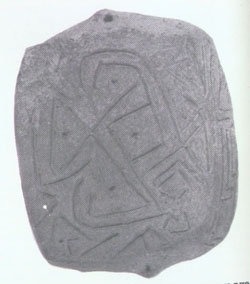
Personal revelations (or devolving into temporary madness) aside, the Vinča symbols are fascinating bits of history. There has been some debate over what exactly there are. Some think they are actual symbols for a written language. Some think they are proto-writing (symbols used to convey a message that are not codified in any way). Others state they are neither of these things, but merely artistic renditions on ancient pottery. Most of these people however don't disagree that the symbols are often found on things that have some connection to religious life. We'll discuss three of the more spectacular discoveries of things with the Vinča symbols on them, 1) the Tărtăria tablets, 2) the Gradeshnitsa tablets and 3) the Dispilio tablet.

The Tărtăria tablets were found in Tărtăria, Romania in 1961. The tablets date to around 5300 BC and were found with a host of stone and clay figurines, a bracelet and the burnt remains of an adult male. The tablets were originally made of unbaked clay. When they were discovered they had to be baked in order to preserve them for future generations of bloggers to comment on for the twelve or so readers he thinks he has. As you can see from the picture, two of the tablets are rectangular, while one is a circle.  The bottom rectangle has some horned animal and some other pictograph symbols on it. The other two have mostly abstract symbols on them. It's the abstract symbols that make some believe this has to be written language, or proto-writing. There isn't much debate though over the importance of the burnt man whose grave had the tablets. He was important. Other Vinča graves don't have such nice grave goods, ergo, the man was important. Some have speculated he was a shaman and these tablets, along with the idols and bracelet had some sort of religious significance. However, as I look at them now and study them, the explanation is simple. The top rectangular tablet is a recipe for dog soup. On the far left is an indecipherable symbol, but the second from the left is a chalice. Next to it is saffron. Next to it, is a symbol of a dog. Next to it is the instructions to put it all in the pot to boil over medium heat. I say medium heat because if you compare it to the cooking symbol on the circular tablet you see the circular cooking has three heat lines coming out of, indicating that it's recipe should be cooked on high heat. Mystery solved.


The Gradeshnitsa tablet was found in the Vratsa Province of Bulgaria in 1969 and date to around the time of the Tărtăria tablets, but are probably a few hundred years newer. Unlike the Tărtăria tablets, which have markings on only one side, the Gradeshnitsta tablet has the symbols on both sides of the clay tablets. Unlike the Tărtăria tablets which clearly indicate cooking recipes and butchery techniques the Gradeshnitsa tablet is much more difficult to decipher. But, in 2006, a Bulgarian-American decided he had deciphered the code. This led to more crazy and in 2012 when I read about it, my eyes bled again. I might need to see an apothecary about this phenomena. It's possible that I could take the bloody tears to the alchemist and we could cook up some gold... What is going on? Is the Vinča script making me crazy or pushing me to a whole new plane of existence? Focus. In short, the Bulgarian-American who decided he had decoded the tablet was debunked. I will say this about them though, one side certainly looks a lot like writing. While it may not be formalized and thus should be categorized as proto-writing, the combination of the Tărtăria tablets and this one give a whole lot of anecdotal evidence to this being proto-writing.

Lastly, the Dispilio tablet was discovered in Greece in 1993. It is roughly contemporaneous to the  Tărtăria tablets and the Gradeshnitsa tablet having been carbon dated to 5260 BC. We're not sure of the exact day it was made, but if we actually are right on the year that's pretty damn impressive. What makes the Dispilio tablet different than the  Tărtăria tablets or the Gradeshnitsa tablet is that the Dispilio tablet is wooden and not clay. The wooden tablet had long been preserved in the mud around the Greek village of Dispilio so when it was unearthed it suffered serious damage. It's currently undergoing surgery to preserve it. The markings on this tablet are hard to make out, but many of the known Vinča symbols are on it, so we know that it came from that culture. The site has produced a number of interesting finds, including the oldest known flute in Europe. But all of this pales to the intrigue that another Vinča tablet provides. Coupled with the aforementioned tablets the arguement for proto-writing among this Neolithic people just keeps getting stronger. The idea that this is somehow related to a foolish theory of everything hypothesis that makes people's eyes bleed gets weaker with every discovery. Thankfully, pupils everywhere can relax in peace, for now...

Sunday, May 13, 2012

The Early Days of Stara Zagora

Stara Zagora is a city of about 200,000 people, making it Bulgaria's sixth most populated city. Officially, Stara Zagora got its name in 1875, but the city's history stretches back at least 8,000 years. In the meantime the city has had a host of names depending on who was in control. The city was held by Neolithic peoples, who if they had a name for the area weren't kind enough to jot it down for us. Prior to the Roman arrival the city was held variously by Greeks and Thracians, who called the city Beroe. In 106 AD the Roman provincial city was founded and named Augusta Traiana. Some time in the 4th century the city was renamed Beroe and was a center for Christianity in the Balkans. That named lasted until the city caught the eye of the Byzantine princess Irene, and the city became known as Irinopolis. When the Bulgarians broke from the Byzantines the city was re-re-re-re-refounded (give or take 2 re's) as Vereya (or Bereya or Beroya, presumably after the earlier name Beroe). As a city in the Bulgarian Empire, it was an important financial center. In a later installment of the various Bulgarian kingdoms of the Middle Ages it was called Boruy. When the Ottoman Empire captured it, the city was called Eski Zagara, which means the Old Fortress of Zagora. When the Bulgarians gained their independence the city was renamed again to Zheleznik, but was shortly renamed Stara Zagora. During this shuffling of names, one of the areas of the city called the Bereketska Mound was continually inhabited from about 6000 BC - 1200 AD. The Bereketska Mound is just one a whole treasure chest full of archeological sites in one of Europe's longest inhabited city.

The Bereketska Mound is about one of a hundred or so mounds in the area that contain burial items dating back to the Neolithic period. The Azmashka Tomb was one of the earliest sites in Southeastern Europe to receive a full archeological treatment. It has produced a wealth of data and artifacts, including the Venus Figurine to the right. Stara Zagora is also host to the Metchi Kladenets, one of, if not the earliest copper mine in Europe. The copper that was mined there produced copper tools that were traded all over the region, some traveling as far north as the Volga River in Russia. In addition to all these Neolithic Artifacts, there are great collections of Classical Thracian, Roman, Byzantine, Medieval Bulgarian, Russian and Ottoman artifacts, but we'll save these for later.

Friday, May 11, 2012

Dimitar's Prehistoric Bulgaria

Prehistoric Bulgaria was a fascinating place. Long before the most sensual man alive according to himself via a the dirty tackle, Dimitar Berbatov was born there was the Bacho Kiro Cave, Stara Zagora and the Varna Culture. Dimitar however is pointing us in the right direction.

The Bacho Kiro Cave is an ancient cave formed by the Andaka and Dryanovska Rivers. The cave became inhabited by the prehistoric peoples of Bulgaria in the Paleolithic period. Well, that might actually be a misnomer. The cave was actually the habitat of the Cave Bears that roamed the earth during the late Paleolithic. Had Dimitar Berbatov, the scorer of erotic goals been born 30,000 years ago he could've very well ended up as a snack for this Prehistoric Bulgarian Bear. The vast majority of the early remains in Bulgaria, aren't constructions by early modern humans known as Cro-Magnon man, rather their gnawed on skeletal remains. It's rather grizzly stuff... ah ha, that was a terrible pun!

As man became more dominant on the Eurasian land mass and the cave bears died out, prehistoric Bulgaria began to flourish. Stara Zagora, Bulgaria's 6th largest city grew into a prehistoric hotbed of early human burial grounds. The city of Stara Zagora is actually one of Europe's oldest, having been populated for the last 8000 years continuously. The earliest copper mines in all of Europe date to Star Zagora in the 5th millennium BC. It is my belief that Dimitar is pointing back all those many millennia in this picture. That's why his eyes are so rapturing. They are truly breathtaking in this picture... I suddenly have an inexplicable urge for mayonnaise!

Bulgaria would eventually become over run by the Vinča Culture in the Neolithic era. The Vinča Culture would span 5500 BC - 4500 BC and revolutionize the area and drag it into the pottery making farming industry that would, through various evolutions become today's Bulgaria. The Vinča Culture, at its height would cover regions of modern day Serbia, Bulgaria, Bosnia, Montenegro, Macedonia, Romania and Greece. The Vinča Culture arose is Serbia, but it played out in Bulgaria. The early Bulgarians were split between history and progress. Some liked to live in newish devices like houses, either built of wood and earth (See Wattle-and-Daub) or dug into the ground like hobbit holes. Others preferred to stay in the caves of their ancestors. These latter types of folks dedicated their spare time to painting their home caves, such as the Magura Cave, nearby present day Rabisha. Both the house dwelling and cave folk would coallece to form the Vinča, who in turn would provide the world with pure sensuality, in Dimitar. Man I love his widow's peak! It almost makes me pine for dignity in old age....