Transnistria is the last of the disputed territories we're going to cover this week. We've touched on Kosovo, Northern Cyprus and the Caucusus' states of Abkhazia, Nagorno-Karabakh, and South Ossetia already. Transnistria is not a member of the Caucusus region, but Transnistria's independence claims stem from the collapse of the USSR like these Caucusus would-be nations. Transnistria is sandwiched between the Ukraine and Moldova. Moldova, from whom they claimed independence, doesn't not recognize them and still holds Transnistria as part of its sovereign territory. Transnistria has a much older history though than the current independent or not state.
In prehistoric times and antiquity it was occupied Dacian and Scythian tribes, settled by Greek colonists at Tyras and eventually became a Thracian homeland to a branch of the Getae. The area would fall under the sway of the Roman Empire in 56 AD when Rome rebuilt the city of Tyras along the Black Sea. Tyras would become an important minting city for Rome and over a couple of centuries this city in what Rome called Lower Moesia. Numerous copper coins would go out from Tyras throughout the whole empire.
As the Western Roman Empire was collapsing the area would see a whole host of people groups swing through, including the Goths and the Huns. The Huns would destroy the city of Tyras but the Goths would stick around for centuries and live throughout Transnistria. Then the Slavic peoples migrated through the area, both Southern and Eastern tribes. Also various Turkic peoples would settle and then move sometimes living alongside Slavic tribes and other times displacing them. The area would eventually become dominated by a Turkic confederation by a tribe called the Cumans. Cumania, a land more or less controlled by this semi-nomadic confederation stretched from the Balkans in the west to the Caucusus and further east into modern Iran. This large swathe of land brought them into conflict with the new threat from the east, the Mongols. But the Mongols didn't establish any tangible permanent legacy and the region entered part of the Kievan Rus' sphere of influence.
At about the turn of the 15th century the area became part of the Grand Duchy of Lithuania and then part of the Lithuanian-Polish Commonwealth. This would last for nearly 300 years until the area was taken over by the Russian Empire in 1792 and 1793. By this time the area was occupied primarily ethnic Moldavian, ethnic Ukrainian and a number of various Tatar peoples (one of the few holdovers from Mongol invasions). Under Russian influence which lasted from 1793 until the Russian Revolution in 1917 the area was heavily colonized. Russian peasants were moved there to be given land (as all of the Russian land was in the hands of noble Russians). Also, Jews and Germans were moved to the region to help build up the economy.
After the fall of the Russian Empire and the dawn of the USSR, Transnistria became a part of the Socialist Republic of Moldova under the power of the Kremlin. The area was not given any rest though as it was invaded during World War II when it came under the control of Romania. Romania instituted a strict Romanianization program over the area and a multitude of Ukrainian and Moldovan Jews were either killed or sent to concentration camps by combined Romanian and German forces. Other ethnic groups were relocated and forced to move. After the war the Soviets reacquired the region but took a page out of German/Romanian playbook and relocated numerous Moldovan and Romanian families, often eastward to places like Kazakhstan and Siberia.
In the late 1980's as the USSR was coming apart at the seams the Moldovan authorities pushed for more autonomy and power. They readopted the Latin alphabet, declared Moldovan to be the only official language of the region and declared the closeness of Moldovan and Romanian linguistic heritage. This nationalism and ethnic posturing caused many Russian speaking and Slavic ethnic groups to become very uncomfortable. They were worried about two major things. First, the rhetoric of some of the Moldovan groups was very damning to non-Moldovan/Romanian people living within Moldova. Second, they were terrified by a reunification of Romania and Moldova.
In response to all of this war broke out as the people who did not want to return to a Romanian-Moldovan alliance attempted to break away from Moldova. From 1990 - 1992 war between Moldovan and Romanian forces against the breakaway region raged. Transnistria would have been easily crushed had it not been for support they received from official elements of the Russian army, Russian volunteers and Ukrainian volunteers. As a result of the war Transnistria has been a de facto state since 1992, only it has been almost entirely recognized as a part of Moldova by the international community.
Since 1992, the government of the Pridnestrovian Moldavian Republic (Transnistria) has been ruled from its capital of Tiraspol, a city built on or near the ruins of the Greek settlement of Tyras by the Russians in 1792. The population of Transnistria is over 30% Moldovan, making it the largest percentage of the population. However, ethnic Russians and Ukrainians combine for a near 60% of the population. Thus, they speak Slavic based Russian language and use the Cyrillic alphabet in Transnistria as opposed to the Romance based Moldovan language and Latin alphabet used in Moldova. Tensions still simmer in this disputed region, especially given the fact that FC Sheriff Tiraspol dominates the Moldovan Football League. In a recent BBC World Football report it was noted that crossing the border from Moldova to Transnistria for a football match was a lot like crossing the border back into the days of the USSR, murals, police checkpoints, complete with hammer & sickle and all. It is a starkly different place than both Moldova and Ukraine which border it.
Showing posts with label Greece. Show all posts
Saturday, August 11, 2012
A Short Look at Transnistria
Labels:
Germany,
Greece,
Lithuania,
Modern European History,
Moldova,
Poland,
Roman Empire,
Romania,
Russia,
Transnistria,
Ukraine,
USSR
Thursday, August 9, 2012
A Quick Survey of Northern Cyprus
Northern Cyprus is another one of those disputed areas of sovereignty that we said we would cover this week on the blog. It has only one state outside of itself that recognizes, Turkey. The rest of the world considers Northern Cyprus to be an occupied territory within the Republic of Cyprus. The question we want to get to the bottom is what is all the kerfuffle about?
It started long ago and with many of our other disputed states this week it has to do with ethnic and religious tensions. In the case of Northern Cyprus we are talking about the Greek Cypriots and the Turkish Cypriots. The Greek Cypriots occupy most of the island while the Turkish Cypriots live in the Northeastern part of the island called Northern Cyprus. The island of Cyprus has an extensive history, one we're not going to cover on this blog post. So, we'll start with the most recent tensions that began shortly after 1960 when the island became independent from England.
There were two competing thoughts on what to do with the islands new found independence. Many Turkish Cypriots wanted to adopt "takism", the Turkish word for partition. This theory of self-rule wanted to split the island into two sections and possibly two distinct states, one for the Greeks and one for the Turks. Many Greek Cypriots however wanted to adopt the policy of "enosis", the Greek word for union. Under this plan Cyprus would become part of Greece. But, in 1960 delegates from both sides agreed to scrap both policies to make Cyprus its own state. The peace however did not last.
In 1963 the Akritas Plan was enacted that was designed to weaken the position of the Turkish Cypriots in the government and ultimately link Cyprus back with Greece. Violence broke out between the Turkish and Greek Cypriots with the Turks getting the worse end of the violence. Looting of Turkish villages within the island nation caused thousands to either withdraw into what would over time become Northern Cyprus or to emigrate to places like Britain, Australia or Turkey proper. The Turkish Cypriot government withdrew from all official government activities and Turkish paramilitary groups began to form that in effect created the partition of the island that constitutes it today.
The 1970's saw some serious action on the island. In 1974 the military junta of Greece decided to directly involve themselves in Cypriot politics and backed a couple of Greek Cypriot groups to host a coup d'état party. They ousted the presiding president, Makarios III, the president that had basically unilaterally acted back in the early 60's to get the tensions snowballing into the spiral as they did. But, Turkey saw this military intervention by Greece as a reason to send in their own troops. The Turkish Army came in shortly after the coup and established the border between Cyprus proper and Northern Cyprus.
A year later, in 1975 the Turkish Cypriots formed the Turkish Federated State of Cyprus. This however displeased the Republic of Cyprus and no one in the international community outside of Turkey recognized this new designation. The hopeful and nascent Turkish Federated State of Cyprus tried to negotiate with the UN and the leaders of the Greek Cypriots but to no avail. After eight years the Turkish Cypriots declared independence and formed the disputed state that sits atop northeastern Cyprus today, the Turkish Republic of Northern Cyprus. Since 1983 there has been a whole bunch of bluster about the politics of reunification. In 2004 the Greek Cypriots overwhelmingly voted against reunification whereas the Turkish north voted for it. This left Cyprus entering the European Union with the North basically left out of the deal. In spite of all the hope for unification continuing sanctions has disillusioned much of the Northern Cyprus population and they recently voted in a government that prefers independence to unification and links with Turkey rather than the EU. But, while this current government is ideologically at odds with unification it is pragmatic and the current president Derviş Eroğlu is still performing ongoing negotiations with the Republic of Cyprus on unification plans.
That's all we'll cover this time, but look this week for a further explanation on the divisions within Cyprus through a historical lens and more on the disputed states in Europe. Tomorrow, barring something horrible, the podcast will resume with the Chalcolithic podcast. I'm excited. I hope you are!
Labels:
Cyprus,
Greece,
Modern European History,
Northern Cyprus,
Turkey
Sunday, May 27, 2012
The Vinča culture
![]() |
| The Lady |
Anyway, the Vinča culture existed in Southeastern Europe from around 5500 BC - 4500 BC, specifically in modern Kosovo, Serbia, Romania, Bulgaria, Bosnia, Montenegro, Macedonia and Greece. The origins of the Vinča culture are debated. Some think that they migrated to the Balkans from Anatolia while others think they developed naturally out of the rich Starčevo–Kőrös–Criş culture and were local to the area. Either way they were a Neolithic culture that farmed, made pottery, raised livestock and supplemented it all with hunting and gathering. The Vinča are best known because of the Vinča symbols we discussed earlier. But when they weren't making pre or proto-language they were carving fantastic figurines.
The Vinča produced a number of fascinating sculptures, including the Lady of the Vinča. This idol, that dates to around 5000 BC was found near Belgrade in 1929. It shows a sophisticated craftsmanship. If you remember the Starčevo–Kőrös–Criş culture was a rich religious culture that was fascinated with fish gods. It produced troves of fish-men statues associated with a river religion. The Vinča seems to have continued in this religious vein, but switched from river deities to a fertility cult.
When they weren't practicing religion the Vinča were busy developing the first copper tools of Europe. The Vinča site at Pločnik in Serbia unearthed the earliest copper tools in Europe when people were setting up the railroad in the 1920's. Pločnik was inhabited from around 5500 - 4700 BC until the settlement was burned to the ground. But, before the fire took the settlement the people used fire to forge some great prehistoric weaponry.
Labels:
Bosnia and Herzegovina,
Bulgaria,
Greece,
Kosovo,
Macedonia,
Montenegro,
Prehistoric,
Romania,
Serbia
Wednesday, May 23, 2012
Sesklo - The First Neolithic Culture of Europe
The Sesklo Culture is famous for being one of the first Neolithic cultures in Europe. If you remember, a culture becomes a Neolithic one when it discovers how to do one of two things or both. It leaves the Mesolithic to join the the Neolithic when it masters farming or starts building pottery. The Sesklo seem to have done this as early as 6850 BC give or take a margin of error. They did this in what is modern day Greece in the regions of Thessaly and Macedonia. Confusingly, the culture seems to arisen out of two cultures, the Pre-Sesklo and Proto-Sesklo cultures. The distinction is so ridiculously nuanced that I can't seem to wrap my head around it, let alone explain it. But, that's where they come from.
They became Neolithic by learning how to farm wheat and barley. Because Nabisco's Wheat Thins and barley laden Rye Whiskey cannot sustain a man (trust me on this one), the Sesklo culture also kept herds of sheep, goats and a few cows and pigs. They completed the double Neolithic by fashioning bowls and cups to eat and drink out of. The Rye Whiskey though they liked to drink straight from the bottle like a boss.
The Sesklo would have been a minor footnote in history had they not influenced other cultures though. In this they seem to have been prolific. They influenced the Karanovo and the Starčevo–Kőrös–Criş in the Balkans. The Starčevo–Kőrös–Criş would then go on to influence the Danubian cultures that stretched all over Southeastern and Central Europe. The Sesklo also seem to have been the origin for the Cardium pottery Culture that dotted the southern coastal region of much of Europe stretching from Croatia to Italy to France and to Spain. For this reason, the minor city of Sesklo, played a major role in spreading the Neolithic Revolution to much of Europe.
Tuesday, May 22, 2012
On this day in history, Alexander pulls a Mortal Kombat move on Mithridates of Persia
Today we mark the Battle of the Granicus on this day in the history of Europe. For me the battle shapes up like Mortal Kombat in the arcade version, the one where you fight the guy until you finish him off and then another one flashes into the screen with a high kick behind you. Then you have to fight him, doing the same up right low block high kick moves you did to defeat the first opponent, but this time in reverse order.
The Battle of the Granicus was fought on May 22 (give or take, but that's the day most ancient historians give), 334 BC at what was near the even more ancient site of Troy in Northwest Asia Minor (modern Turkey). Back then the river where the battle was fought was called the Granicus, and hence the named battle. Today the place is called Biga Çayı or without the fancy Turkish symbols, the Biga River. One one side was the eventual victors, Alexander and his Ancient Macedonian army and his allies the League of Corinth against the Achaemenid Empire and its many satraps and mercenaries. The reason it feels like a mid-90's installment of Mortal Kombat is because in spite of Alexander's superior numbers, he had to deal with a much larger contingency of Persian leaders. So when his army would smite one branch of the Persians, another would pop in to take on the fight and continue. Had Alexander lost even one of these minor battles he would have had to put in another two tokens to continue. But luckily, he took them all out, and when it was time to finish him, he didn't do a friendship move to turn them all into snowmen.
The Macedonians and Corinthian League had superior numbers, but the Persians had the stronger cavalry at the battle. The Persians lined up on the east bank of the Granicus but Alexander made a swift crossing and engaged the smaller force immediately. The plan worked initially, but a plethora of Persian satraps pushed back. Spithridates, the satrap of Ionia and Lydia knocked Alexander off his horse and as he was winding up for the death blow and the quick end to Alexander's wars in the east his arm was hacked off by the Macedonian Cletius the Black. After losing his arm he was no match for Cletius and was quickly killed. Alexander hopped back on a horse and led a reinvigorated charge that decimated the middle of the Persian defense. Had Spithridates not been blocked, so much of history would have been different. The Hellenization of the Mediterranean would have halted and it is possible that the nascent Roman Empire would have been crushed by Persian advancement in the west. But, history wasn't altered and Alexander's second charge smashed and killed many of the best Persian generals and allies leaving their army in total disarray.
Wednesday, May 16, 2012
Thank you for the bacon, Prehistoric Turkey, Part III, the Neolithic
Stone Age Turkey really starts to heat up in the Neolithic. Cultures and sites like the Nevalı Çori, Göbekli Tepe, Mersin, Çatalhöyük and the Çayönü shape up Turkey's Stone Age history.
The Nevalı Çori was an early Neolithic settlement in Eastern Turkey along the Euphrates river. It's known for a number of things, including its early association with temple building. The village at Nevalı Çori consisted of some long houses and a central site for worship. The temple was built into the hillside at the site and contained a number of figurines, indicating an early religious cult. The votive offerings that these figurines probably represent show an advanced technology. Basically the people of Nevalı Çori had figured out how to fire pottery without actually making pottery.
Göbekli Tepe is oldest known religious structure in the world. It is a megalithic structure that was built around 12,000 years ago by some hunter-gatherers. The construction is incredible. It contains giant limestone structures that have carved images of lions, bulls, boars, foxes, gazelles, donkeys, snakes and various reptiles. The site actually predates Neolithic economies, no domestication of plants or animals or pottery is associated with the site. It could be termed a Mesolithic site, but since the megalithic culture of Europe is associated with the Neolithic period, we'll include it here. Only a small portion of the site has been excavated, so more will come out of it as the site is fully discovered. However the immense size of the structure has really shaken up anthropological and archeological theories, pushing dates much further into antiquity than previously imagined.
Mersin is a South-central port city in modern day Turkey that show signs of inhabitation dating back to 6300 BC. The Yumuktepe hill is a a tumulus that has produced both stone and ceramic tools that date back to the earliest period. This Neolithic site would go on to be an important settlement for the Assyrians, Persians, Greeks and Selucid Empire that covered most of the Classical History of the region.
The Çatalhöyük site flourished from around 7500 BC - 5700 BC in southern Turkey. One of the distinctive features of this site is its mother goddess figurines. The area has produced an immense number of artifacts, cementing its place as an important spot for the evolution of religion. It is among the best preserved and largest Neolithic settlements in all of Europe.
Çayönü is located in Southeastern Turkey. It flourished from around 7200 BC - 6600 BC and was related to the Çatalhöyük site as a possible influence. Unlike the Mersin site that flourished along the Euphrates, the Çayönü was located at the base of mountains near the mouth of the Tigris. It is notable because it might have been the place where pigs were first domesticated. Bacon enthusiasts everywhere are indebted to the Çayönü. Beyond that the Çayönü domesticated a number of cereals that have continued down to the present day.
The Nevalı Çori was an early Neolithic settlement in Eastern Turkey along the Euphrates river. It's known for a number of things, including its early association with temple building. The village at Nevalı Çori consisted of some long houses and a central site for worship. The temple was built into the hillside at the site and contained a number of figurines, indicating an early religious cult. The votive offerings that these figurines probably represent show an advanced technology. Basically the people of Nevalı Çori had figured out how to fire pottery without actually making pottery.
Göbekli Tepe is oldest known religious structure in the world. It is a megalithic structure that was built around 12,000 years ago by some hunter-gatherers. The construction is incredible. It contains giant limestone structures that have carved images of lions, bulls, boars, foxes, gazelles, donkeys, snakes and various reptiles. The site actually predates Neolithic economies, no domestication of plants or animals or pottery is associated with the site. It could be termed a Mesolithic site, but since the megalithic culture of Europe is associated with the Neolithic period, we'll include it here. Only a small portion of the site has been excavated, so more will come out of it as the site is fully discovered. However the immense size of the structure has really shaken up anthropological and archeological theories, pushing dates much further into antiquity than previously imagined.
Mersin is a South-central port city in modern day Turkey that show signs of inhabitation dating back to 6300 BC. The Yumuktepe hill is a a tumulus that has produced both stone and ceramic tools that date back to the earliest period. This Neolithic site would go on to be an important settlement for the Assyrians, Persians, Greeks and Selucid Empire that covered most of the Classical History of the region.The Çatalhöyük site flourished from around 7500 BC - 5700 BC in southern Turkey. One of the distinctive features of this site is its mother goddess figurines. The area has produced an immense number of artifacts, cementing its place as an important spot for the evolution of religion. It is among the best preserved and largest Neolithic settlements in all of Europe.
Çayönü is located in Southeastern Turkey. It flourished from around 7200 BC - 6600 BC and was related to the Çatalhöyük site as a possible influence. Unlike the Mersin site that flourished along the Euphrates, the Çayönü was located at the base of mountains near the mouth of the Tigris. It is notable because it might have been the place where pigs were first domesticated. Bacon enthusiasts everywhere are indebted to the Çayönü. Beyond that the Çayönü domesticated a number of cereals that have continued down to the present day.
The Prehistoric History of Turkey, Part I, the Paleolithic
Turkey is one of those countries that straddles Europe and Asia. For me, trying to do a European History podcast, Turkey marks a dilemma. I can't leave it out, because the Thracians, Greeks and Byzantines are certainly a part of Europe's heritage. So too are the Seljuk Turks and the Ottomans. But at the same time, it's east of the Bosporus and technically an Asian country. I'm at a loss!!! But, because the peoples of modern day Turkey have had such an impact on Southeastern Europe and the Balkans I have to include them somewhere. Turkey didn't make the cut in the Paleolithic, Mesolithic or Neolithic podcast except through tangential relationships so I'm going to blog about them. While modern day Turkey continues to debate admittance to the European Union, I won't dally any longer. Turkey has a rich European history and we'll include them in our studies. So here is a sweeping overview of her history up to the Chalcolithic period.
The Turkish region of Anatolia is one of the longest, continuously inhabited places in the world. Paleolithic evidence dates to sites like the Karain Cave, the Belbaşi Culture and a whole host of sites we'll not really cover here because of space reasons. The earliest sites of Anatolia, or Asia Minor in Latinized terminology date to around 500,000 BC. While this rich cultural heritage deserves about a hundred thousand pages of a well documented book, we'll do our best with a couple of blog posts. So let's just focus on the two aforementioned Paleolithic sites.
Karain Cave shows evidence of human inhabitation dating from around 200,000 years ago. It's located in the Antalya region of modern day Turkey, near the Southwest coast along the Mediterranean Sea. The artifacts found at this cave are hosted in the Museum of Anatolian Civilizations located in Ankara, established in 1921. It is an UNESCO World Heritage Site, that contains everything from prehistoric hippopotami bones to early Greek inscriptions carved into the walls. Basically the cave complex has a rich million year history that shows some of the earliest human endeavors in Turkey.
The Belbaşi Culture is an ancient Paleolithic/Mesolithic Culture of tool making that spawns from a number of cave sites in the Southwest of modern day Turkey. It has findings of tanged arrowheads and other artifacts. Its artifacts are similar to those of the Kebaran Culture, a site named after the artifacts found near Haifa in modern day Israel and the Natufian Culture, a Levantine Culture that existed from 13,000 - 9,800 years ago in modern Israel, Syria, Lebanon and Turkey. But, while the Belbaşi Culture had eastwards roots, it expanded and changed westward. The Belbaşi Culture seems to have taught the cultures of the Balkans and Southeastern Europe how to farm and domesticate animals, making it an important predecessor culture for our studies.
The culture learned to craft tools from obsidian, flint, bone and antler. It coupled this technology with new farming techniques that made it a Neolithic culture. In addition to to adapting to farming techniques it created pottery that would revolutionize Southeastern European pottery in the coming times. These cavemen would eventually build houses in the Balkan countries of Greece, Macedonia, Serbia and Bulgaria before branching north to Romania to follow the Danube and become subsumed by the Danubian Cultures. It's truly fascinating that prehistoric peoples in Turkey would have an impact on those in Germany.
Tuesday, May 15, 2012
History's Mysteries: The Vinča symbols
![]() |
| The known Vinča symbols |
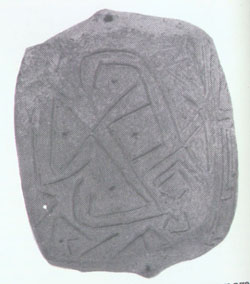
Personal revelations (or devolving into temporary madness) aside, the Vinča symbols are fascinating bits of history. There has been some debate over what exactly there are. Some think they are actual symbols for a written language. Some think they are proto-writing (symbols used to convey a message that are not codified in any way). Others state they are neither of these things, but merely artistic renditions on ancient pottery. Most of these people however don't disagree that the symbols are often found on things that have some connection to religious life. We'll discuss three of the more spectacular discoveries of things with the Vinča symbols on them, 1) the Tărtăria tablets, 2) the Gradeshnitsa tablets and 3) the Dispilio tablet.
The Tărtăria tablets were found in Tărtăria, Romania in 1961. The tablets date to around 5300 BC and were found with a host of stone and clay figurines, a bracelet and the burnt remains of an adult male. The tablets were originally made of unbaked clay. When they were discovered they had to be baked in order to preserve them for future generations of bloggers to comment on for the twelve or so readers he thinks he has. As you can see from the picture, two of the tablets are rectangular, while one is a circle. The bottom rectangle has some horned animal and some other pictograph symbols on it. The other two have mostly abstract symbols on them. It's the abstract symbols that make some believe this has to be written language, or proto-writing. There isn't much debate though over the importance of the burnt man whose grave had the tablets. He was important. Other Vinča graves don't have such nice grave goods, ergo, the man was important. Some have speculated he was a shaman and these tablets, along with the idols and bracelet had some sort of religious significance. However, as I look at them now and study them, the explanation is simple. The top rectangular tablet is a recipe for dog soup. On the far left is an indecipherable symbol, but the second from the left is a chalice. Next to it is saffron. Next to it, is a symbol of a dog. Next to it is the instructions to put it all in the pot to boil over medium heat. I say medium heat because if you compare it to the cooking symbol on the circular tablet you see the circular cooking has three heat lines coming out of, indicating that it's recipe should be cooked on high heat. Mystery solved.
The Gradeshnitsa tablet was found in the Vratsa Province of Bulgaria in 1969 and date to around the time of the Tărtăria tablets, but are probably a few hundred years newer. Unlike the Tărtăria tablets, which have markings on only one side, the Gradeshnitsta tablet has the symbols on both sides of the clay tablets. Unlike the Tărtăria tablets which clearly indicate cooking recipes and butchery techniques the Gradeshnitsa tablet is much more difficult to decipher. But, in 2006, a Bulgarian-American decided he had deciphered the code. This led to more crazy and in 2012 when I read about it, my eyes bled again. I might need to see an apothecary about this phenomena. It's possible that I could take the bloody tears to the alchemist and we could cook up some gold... What is going on? Is the Vinča script making me crazy or pushing me to a whole new plane of existence? Focus. In short, the Bulgarian-American who decided he had decoded the tablet was debunked. I will say this about them though, one side certainly looks a lot like writing. While it may not be formalized and thus should be categorized as proto-writing, the combination of the Tărtăria tablets and this one give a whole lot of anecdotal evidence to this being proto-writing.Lastly, the Dispilio tablet was discovered in Greece in 1993. It is roughly contemporaneous to the Tărtăria tablets and the Gradeshnitsa tablet having been carbon dated to 5260 BC. We're not sure of the exact day it was made, but if we actually are right on the year that's pretty damn impressive. What makes the Dispilio tablet different than the Tărtăria tablets or the Gradeshnitsa tablet is that the Dispilio tablet is wooden and not clay. The wooden tablet had long been preserved in the mud around the Greek village of Dispilio so when it was unearthed it suffered serious damage. It's currently undergoing surgery to preserve it. The markings on this tablet are hard to make out, but many of the known Vinča symbols are on it, so we know that it came from that culture. The site has produced a number of interesting finds, including the oldest known flute in Europe. But all of this pales to the intrigue that another Vinča tablet provides. Coupled with the aforementioned tablets the arguement for proto-writing among this Neolithic people just keeps getting stronger. The idea that this is somehow related to a foolish theory of everything hypothesis that makes people's eyes bleed gets weaker with every discovery. Thankfully, pupils everywhere can relax in peace, for now...
Labels:
Bosnia and Herzegovina,
Bulgaria,
Greece,
Macedonia,
Montenegro,
Prehistoric,
Romania,
Serbia
Friday, May 11, 2012
Dimitar's Prehistoric Bulgaria
Prehistoric Bulgaria was a fascinating place. Long before
the most sensual man alive according to himself via a the dirty tackle,
Dimitar Berbatov was born there was the Bacho Kiro Cave, Stara Zagora and the
Varna Culture. Dimitar however is pointing us in the right direction.
The Bacho Kiro Cave is an ancient cave formed by the
Andaka and Dryanovska Rivers. The cave became inhabited by the prehistoric
peoples of Bulgaria in the Paleolithic period. Well, that might actually be a
misnomer. The cave was actually the habitat of the Cave Bears that roamed the
earth during the late Paleolithic. Had Dimitar Berbatov, the scorer of erotic
goals been born 30,000 years ago he could've very well ended up as a snack for
this Prehistoric Bulgarian Bear. The vast majority of the early remains in
Bulgaria, aren't constructions by early modern humans known as Cro-Magnon man,
rather their gnawed on skeletal remains. It's rather grizzly stuff... ah ha,
that was a terrible pun!
As man became more dominant on the Eurasian land mass and
the cave bears died out, prehistoric Bulgaria began to flourish. Stara Zagora,
Bulgaria's 6th largest city grew into a prehistoric hotbed of early human
burial grounds. The city of Stara Zagora is actually one of Europe's oldest,
having been populated for the last 8000 years continuously. The earliest copper
mines in all of Europe date to Star Zagora in the 5th millennium BC. It is my
belief that Dimitar is pointing back all those many millennia in this picture.
That's why his eyes are so rapturing. They are truly breathtaking in this
picture... I suddenly have an inexplicable urge for mayonnaise!
Bulgaria would eventually become over run by the Vinča
Culture in the Neolithic era. The Vinča Culture would span 5500 BC - 4500 BC and revolutionize the area and drag it into the pottery making farming industry that would, through various evolutions become today's Bulgaria. The Vinča Culture, at its height would cover regions of modern day Serbia, Bulgaria, Bosnia, Montenegro, Macedonia, Romania and Greece. The Vinča Culture arose is Serbia, but it played out in Bulgaria. The early Bulgarians were split between history and progress. Some liked to live in newish devices like houses, either built of wood and earth (See Wattle-and-Daub) or dug into the ground like hobbit holes. Others preferred to stay in the caves of their ancestors. These latter types of folks dedicated their spare time to painting their home caves, such as the Magura Cave, nearby present day Rabisha. Both the house dwelling and cave folk would coallece to form the Vinča, who in turn would provide the world with pure sensuality, in Dimitar. Man I love his widow's peak! It almost makes me pine for dignity in old age....
Labels:
Bosnia and Herzegovina,
Bulgaria,
Greece,
Macedonia,
Montenegro,
Prehistoric,
Romania,
Serbia
Tuesday, May 8, 2012
Take your daily supplements - today have a taste of Neolithic Bosnia and Herzegovina
The Neolithic podcasts are coming! The first episode should come out on Thursday May 10, but may be a day late. I'm going to try really hard though to not let it be late. However, the Neolithic was so large I had to split it into two podcasts. Even still, I had to edit out a bunch of things that I would have liked to have included. So, I'm doing some blogging on the bits that have been edited out. A couple of those edits come from within the territory of modern day Bosnia and Herzegovina.
On the podcasts we talk a bit about Southeastern Europe and the Balkans not having a lengthy Mesolithic because farming came so quickly to the area, the same can be said about Bosnia & Herzegovina. But, the history of this nation began all the way back in the Paleolithic. A site known as the Badanj Cave was painted by Paleolithic man as early as 16,000 BC and is the oldest Paleolithic monument site in the region. Here you can see a picture of one of the engravings found in the cave. It is a picture of a horse being attacked by arrows. To me it looks a bit abstract...
While this is an interesting find, it shows a culture that was fairly isolated. The Neolithic however, paints a different picture of cultures intermingling and becoming fresh and new. One example of this is the Butmir Culture that thrived in the 3rd millennium BC. What made this culture so unique is their characteristic pottery. If you have listened to the podcasts or read most of the blog posts about prehistoric cultures you'll find that al of them are "known by their characteristic pottery". Over the past few weeks I have looked at probably two thousand pieces of pottery in pictures. There are some obvious distinctions based on shape. But, some of the detail that archeologists are able to label as characteristic takes an expertise that I am sorely lacking. I try to rely then on the most accepted theories and present alternatives when the dissenting voice is loud enough. But I now find myself looking at my dishes and saying things like, "this is an IKEA culture dish" or "this is a ProtoIKEA culture dish", or "what is this MesoIKEA dish doing where all of the PaleoWalMart dishes are hanging out". I say these things and then chuckle to myself. I'm really starting to become alarmed.
But, in addition to becoming a bit weird when looking at dinnerware I am becoming increasingly fascinated with the interchange of cultures. That is one of the reasons why the Butmir Culture interests me so much. The Butmir Culture is named after the town of Butmir, which is near Sarajevo. The site was discovered when the Austrian-Hungarian Empire was expanding the agricultural university of Sarajevo in the late 19th century. The site so intrigued scholars all over Europe that they held an archeological festival (which in my mind resembles Comic Con) at Sarajevo in 1894. This archeological get together produced a wide variety of theories about the new discovery of the Butmir Culture. The distinctive pottery was similar enough to later Minoan pottery on the island of Crete that it led some to suggest that the Butmir was a precursor to the famous Minoans of Crete. This theory isn't widely held today. Instead people think that the Butmir Culture was a bit of a cosmopolitan hot spot for their age. They took on the cultures of the Aegean, the Balkans, Pannonia, and Mediterranean to create their distinctive lifestyle. This would mean that Bosnia & Herzegovina from an early time was taking in ideas from far flung regions that in today's terms we would describe as Hungary, Austria, Slovakia, Serbia, Slovenia, Croatia, Mainland Greece, the Greek isles, including Crete and Italy to create a style that was all their own. This is why history fascinates me so much!
On the podcasts we talk a bit about Southeastern Europe and the Balkans not having a lengthy Mesolithic because farming came so quickly to the area, the same can be said about Bosnia & Herzegovina. But, the history of this nation began all the way back in the Paleolithic. A site known as the Badanj Cave was painted by Paleolithic man as early as 16,000 BC and is the oldest Paleolithic monument site in the region. Here you can see a picture of one of the engravings found in the cave. It is a picture of a horse being attacked by arrows. To me it looks a bit abstract...
While this is an interesting find, it shows a culture that was fairly isolated. The Neolithic however, paints a different picture of cultures intermingling and becoming fresh and new. One example of this is the Butmir Culture that thrived in the 3rd millennium BC. What made this culture so unique is their characteristic pottery. If you have listened to the podcasts or read most of the blog posts about prehistoric cultures you'll find that al of them are "known by their characteristic pottery". Over the past few weeks I have looked at probably two thousand pieces of pottery in pictures. There are some obvious distinctions based on shape. But, some of the detail that archeologists are able to label as characteristic takes an expertise that I am sorely lacking. I try to rely then on the most accepted theories and present alternatives when the dissenting voice is loud enough. But I now find myself looking at my dishes and saying things like, "this is an IKEA culture dish" or "this is a ProtoIKEA culture dish", or "what is this MesoIKEA dish doing where all of the PaleoWalMart dishes are hanging out". I say these things and then chuckle to myself. I'm really starting to become alarmed.
![]() |
| Distinctive Butmir Pottery. Its swirls are different than all the other swirls from this time. That's how we know it's Butmir! |
Labels:
Austria,
Bosnia and Herzegovina,
Croatia,
France,
Greece,
Hungary,
Italy,
Prehistoric,
Serbia,
Slovakia,
Slovenia
On this day in history, a tax break on account of Visigothic bullying
On May 8, 413 AD the Roman Emperor Honorius decided to give a tax break to most of the provinces of Italy. It wasn't because he was feeling especially generous or that the Roman coffers were so overstuffed he could afford to grant some largesse. It was because the peninsula had been absolutely ravaged by the Visigoths. Three years prior to the tax break, the Visigoths had marched up to the eternal city and sacked it causing a whole bunch of physical, economic and psychological damage to the empire from which it never really recovered. So, while this day marks the anniversary of a fiscal policy enacted some 1599 years ago, the fiscal policy was in response to a seriously traumatic experience. We'll probably touch on the Visigothic sack of Rome at a later date so we'll just give a bit of blog love to the Visigoths today. Pictured here is the Visgothic wave of invasion from Eastern Europe to become lords of Spain. As you can see they entered into Roman territory around 376 and wreaked havoc down into the Balkans, sacking Athens along the way. But on the way to walking triumphantly on the streets of the brain capital of the ancient Mediterranean the Visigoths managed to completely upend the Eastern Empire in 378 at the battle of Adrianople (modern day Turkey). Then the sauntered on up the coast and down into Italy, sacking Rome in 410. They would go on to establish a kingdom in 418 that would stretch from the South Atlantic coast of Portugal up through most of modern day Spain and into France. After claiming such a big stretch of European soil, the Visigoths would go on a slow, but inevitable retreat until finally Ardo, the last of the Visogothic kings was defeated and killed by the Arab conquest of Spain in the 720's. So there you have it. You earn a tax break when you get invaded. I think I could deal with some unruly Visigoths if it got me off the hook for my income tax.
Labels:
Ancient,
France,
Greece,
Italy,
Portugal,
Roman Empire,
This Day in History,
Turkey
Tuesday, May 1, 2012
The Duplicitous Dubrovnikians
Today, I was in Cabarete, Dominican Republic. First, allow
me to plug this delightful seaside town. Cabarete is among my favorite places
that I have ever been. Even then it is a bit of a backwater, it is incredibly
cosmopolitan. I stayed at the Kite Beach Inn, which was unbelievably
affordable, well kept and fantastically run. The place is owned by someone from
Chicago, but currently run by an Italian couple and they were delightful. We
stayed there for two nights for under $65 in an air conditioned room. It is
among the best places I've stayed in Cabarete. The only drawback is to the
hotel is that it is a bit removed from the center of the town where our
favorite places are. However, because of its boonies status, we found this
incredible breakfast nook next to the Dare2fly Kite School. The breakfast nook
was run by a Yugoslavian refugee that fled to the Dominican Republic after she
and her family fled Belgrade after a bombing in 2000.
The breakfast was excellent. It was the first good bagel
I've had since I was in Brooklyn in 2011. As we were leaving the place though I
mentioned that I might be going on a honeymoon to Split, Croatia because of its
history. She however suggested that we go to Dubrovnik, as it was in her
estimation, one of the most gorgeous cities in the world. Interested, I checked
the place out and saw that it had a fascinating history. So without further
ado, here is the brief history of Dubrovnik.
Dubrovnik is currently a Croatian city on the Adriatic
coast. There are a couple of theories as to when it was founded. The older
theory suggests that it was founded sometime in the 7th century AD
by some refugees. However, another theory suggests that the city is much older
and was founded sometime prior to the BC/AD switchover by Greek sailors who
would have likely made it a port between two other Greek settlements in the
area, Budva and Korčula. This
alternate theory is boosted by the presence of a Byzantine basilica from the 8th
century that was large enough to suggest that Dubrovnik was quite populous in
its time. It would have been unlikely to grow so rapidly in an hundred years to
warrant such a large church.
If the latter theory is to be believed the ancient Greek
settlement would have fallen into the hands of the Roman Empire during the
conquest of Dalmatia and then became part of the Ostrogothic kingdom upon the
fall of the Western Empire. From there it seems to have been protected by the
Byzantine Empire in the east and grew to a respectable maritime power in the
region. But, another more famous maritime power decided that this little city
could not be allowed to grow into a more serious threat. Venice began as early
as 948 AD, though with no success. Venice wouldn’t give up on this though and
eventually took over the city and its lands in 1205 during the fourth crusade.
Venice ruled over Dubrovnik for about 150 years. When the
city finally broke free they became the Republic of Ragusa. Being a smallish
kingdom they searched for a big brother to keep them safe. This led them into
the hands of the Ottoman Empire. The Republic of Ragusa remained free, but paid
some cash to the Ottomans for protection. This fended off the Venetians. It
also paid off some dividends. Ragusa got special trade permissions in the
Ottoman Empire and did all of the Ottoman’s business along the Adriatic Sea.
The Republic became quite wealthy and was a viable alternative and fierce rival
of Venice.
It was after it broke free from Venice when it tried its
hands at the double game, playing both sides against the middle. Dubrovnik
looked initially to the Hungarians for some muscle to back them up. Then, to
make sure that Venice wouldn’t try any of its old tricks, the Republic of
Ragusa cozied up to the Ottoman Empire, declaring their allegiance to the
Sultan. This arrangement worked well for a while, but as the Ottomans pushed to
far into Europe it made the Hapsburgs quite cantankerous. The Austrians got
their crew together, including Venice and began to push back. For a little
while the duplicitous Dubrovnikians found themselves paying homage both the
Emperor of Austria and the Sultan of the Ottomans. After the Austrians and
their allies defeated the Ottomans and the Ottomans had to give up a large
chunk of their eastern European holdings Venice began to make a power play at
Ragusa. Venice began to grab up all the land surrounding the republic, which
would have given them a chance to attack Ragusa from both land and sea. But,
Dubrovnik played another master stroke, giving some of their land to the
defeated Ottomans to build a buffer between themselves and Venice. As much as
the Austrians loved to quarrel with the Ottomans they weren’t about to start a
new war so that Venice could snuff out their old rivals.
The double-dealings of the Ragusans could not save them
forever though. After the end of the Austrian – Ottoman conflict simmered down
a bit, the rest of Europe decided to duke it out over the 1700s. Ragusa however
decided to stay neutral. They used their neutrality to trade between enemies
and this somehow worked really well. Until of course Napoleon came along and
screwed everything up for everyone. Napoleon pushed down into the Balkans and
began to gobble up all of the cities and forts along the way. The Russians who
were in the area came up to Dubrovnik and asked to use their very defensible
city against the onslaught of Napoleon’s forces. Ragusa balked and the Russians
besieged the city. But, it would be the French who eventually occupied the
city. Dubrovnik would become a big fish in a small pond as a part of the
Illyrian Provinces of the French Empire. But, Napoleon would have his Waterloo,
which for Napoleon actually was Waterloo and the Republic of Ragusa would be
folded into the Austrian-Hungarian Empire as the Kingdom of Dalmatia. The
Hapsburgs decided however that Dubrovnik had been a seat of power for long
enough. The capital of the newly created puppet kingdom would be Zadar.
Dubrovnik would fall out of fashion and a number of the city’s noble families
would move away. Dubrovnik would last in the Austrian Empire until 1918 when it
was transferred into the State of Slovenes, Croats and Serbs. This little political
experiment wouldn’t last and the city would become a part of Yugoslavia.
Yugoslavia would go from kingdom to socialist republic to bloody civil war and
in the end, Dubrovnik would wind up being in the modern state of Croatia.
Labels:
Austria,
Croatia,
France,
Greece,
Hungary,
Italy,
Middle Ages,
Ottoman Empire,
Russia,
Turkey,
Yugoslavia
Subscribe to:
Posts (Atom)