Showing posts with label Armenia. Show all posts

Thursday, August 23, 2012

Zorats Karer

Stone circles? Bronze Age Graveyard? Refuge from the Romans?
Zorats Karer or Karahunj/Carahunge is a megalithic structure located in Armenia near the city of Sisian, in the southeast of the nation. What it is is a whole bunch of stones placed in a specific pattern. What the stones are though has produced a number of theories.

It could be the "Armenian Stonehenge". Paris Herouni, a late Armenian researcher, would subscribe to this theory. He dated the structure to somewhere in the range of 5600 BC - 2500 BC. This would make the name "Armenian Stonehenge" quite appropriate. Under his theory the stones were set up to mark a map of the celestial sky, specifically the constellation Cygnus. In 2010, an Oxford University professor reexamined the site and confirmed that, in his opinion, the site definitely marks some celestial phenomena. He confirms that the site is most likely a necropolis (as the other theories claim) but that it is linked to the position of the sun, moon and other heavenly bodies.

But, other excavations, like the one carried out by German archeologists disagree with the age and the purpose of Zorats Karer. The German investigation published their thoughts about 12 years ago. They concluded that the structure was more likely a Middle Bronze Age - Iron Age structure. They concluded that the site was a necropolis, something that Herouin and his ilk would not have denied. The Germans did not attach any special interest to the positioning of the stones and celestial movements. They did however speculate that the area became a safe haven for ancient Armenians looking to flee from Roman and/or Persian invasions.

Hole in one of the stones for the purpose of ...? Who knows.
So, at the very least we have a Necropolis dating from some 2000 - 3000 years ago. At best we have the Armenian Stonehenge. To be honest, without much other evidence there isn't a good way of deciding which theory is best. The German expedition doesn't account for the holes in some of the stones that seem to miraculously line up with positions of the sun. Paris and his followers might be guilty of reading a bit too much into the astronomical connection. In all reality though, these theories need not be mutually exclusive. Think of some of the other structures we've covered from the prehistoric times. Later civilizations have come in and incorporated earlier structures into their own use. It's just possible that the Bronze Age Necropolis was fashioned out of an earlier stone circle culture that created some place of worship that corresponded to Cygnus and other constellations over ancient Armenia. And what's to have stopped later Armenians from using the structure as a refuge from invading armies? Nothing. It could be that everyone is right!

Tuesday, August 7, 2012

A brief roundup of Nagorno-Karabakh

Nagorno-Karabakh is another one of those autonomous regions in Europe that is a de facto independent nation that is not fully recognized by other nations. In fact Nagorno-Karabakh Republic is only recognized by three other nations, each of which has recognition problems of their own. The reason for this is because both Azerbaijan and Armenia claim the territory for their own nation.

The ancient history of Nagorno-Karabakh has been covered here in the blog twice as the Kura Araxes culture here and here, so we´ll focus more on what happened after this prehistory. There are some legends surrounding the region. Armenian myths claim that the area was first settled by the progeny of Noah. Then in the 5th century AD a prince was appointed by an Armenian king to run the territory for Armenia. During this period the region suffered from frequent invasions by the Persians and then the Armenians would claim it back. This went on for quite some time until the Mongols and Tartars ending up conquering all of the Caucuses. Nagorno-Karabakh became a semi autonomous region under the Mongols for a few centuries before the Arabs and Persians came into control it. Then it was a nealry autonomous region under Persia. The Christianity of the Armenians however seemed to continue unabated through all of this Muslim control. But, many of the Christian Armenians were displaced and moved into other parts of the Persian Empire. This left the area to the mostly Azerbaijani Tartars.

In the early 19th century the region became part of the Russian Empire. Numerous Armenians migrated back to the region from Persia where they had lived for centuries. This population swell of Armenian Christians tipped the scales so that the region became overwhelmingly Armenian and Christian rather than Azerbaijani and Muslim. Friction would soon arise and after a century of Russian rule conflict brokeout between the Muslim Tartars and Armenian Christians. Within a decade though the Russian Empire was broken up as the Soviets came to power.As the Soviets consolidated power Armenia and Azerbaijan went to war over Nagorno-Karabakh in 1920 to1921.In 1921 the Armenians defeated the Azerbaijani forces, but in the same year the Bolsheviks siezed power in Armenia.

After the Soviets had seized firm enough control in Moscow, they retook the Caucuses including Nagorno-Karabakh. To gain support in Armenia the Bolsheviks promised that Nagorno-Karabakh and a few other predominately ethnic Armenia enclaves within Azerbaijan would fall under Armenian rule within the Soviet Union. But, the Bolsheviks were duplicitous and Nagorno-Karabakh became an autonomous region under Azerbaijani control. From 1921 to 1991, under Soviet rule, ethnic tensions mounted as more and more Azerbaijani settlers moved into the region. The ethnic Armenians in the region resented this turn of events. When the Soviet Union collapsed and Armenia and Azerbaijan became independent states, war broke out between the two over the region.

The war was bloody and consisted of tons of mass ethnic migrations in both Azerbaijan and Armenia. The end result of the war was that nearly all of the ethnic Azerbaijani were driven from Nagorno-Karabakh and ethnic Armenians were driven from various places within Azerbijan. Today, Nagorno-Karabakh is predominately Armenian and they control a small strip of land to connect Armenia to Nagorno-Karabakh. However, Azerbaijan still claims it as part of their nation. Tensions between Armenia and Azerbaijan over the region are still raw and conflict could escalate at any point.

Monday, August 6, 2012

Prehistoric Nagorno-Karabakh, The Kura-Araxes

As we continue to study the history of some of Europe's disputed states we return to the Caucasus in the region known as Nagorno-Karabakh. Currently Nagorno-Karabakh is a disputed territory claiming independence from Azerbaijan. But, way back when in Prehistory the region was the center of a prehistoric culture that spread out from Nagorno-Karabakh in Azerbaijan to Armenia, Georgia, Turkey and four Russian subjects: Chechnya, Dagestan, Ingushetia, and North Ossetia. It is known today as the Kura-Araxes culture, corresponding to the two rivers that flank its homeland.

The Kura-Araxes culture lasted from roughly 3400 BC - 2000 BC. It began as a humble type of civilization subsisting on some farming and mostly cattle. They original built small, round homes that were often grouped together behind some sort of earth and stone fortifications. Hey, this in the neighborhood of most of the projected Urheimats so they were eventually going to have to deal with those violent Indo-Europeans. You can understand why they built walls.

But, their humble beginnings would give way to a much more lavish lifestyle as the Kura-Araxes people became great traders. They traded with Mesopotamia and Asia Minor. There is even evidence that some offshoots of the Kura-Araxes ended up in the Levant after the fall of the ancient Akkadian Empire. What they had to offer had to pretty good considering some of their artifacts have been found flung between modern Israel and Chechnya in Russia. So what did they bring to the table?

First and foremost they brought pottery. Their pottery was super distinctive. It was black and red with geometric ornamentation all over it. They also produced wheeled-carts which when they weren't hauling awesome pottery to trade all over the Ancient Near East and Eastern Europe were probably being traded themselves. Eventually the Kura-Araxes would take up metallurgy and became pretty good smiths. They worked with copper, gold, silver, tin and bronze, adding metal goods to their already impressive arsenal of trade goods.

We've mentioned the Kura-Araxes before way back on May 6, but I thought since we're studying some disputed regions I'd mention them again. But, we've learned quite a bit about history since May so rather than regurgitating what I wrote earlier I thought I'd add something new. Although we're focusing on the History of Europe it's impossible to look at Europe in complete isolation, especially when you're dealing with either the Mediterranean Cultures or the Caucuses. This is because there was massive cultural exchange between these European Cultures and the Asiatic ones. The Kura-Araxes were intercontinental traders and it might be good to mention some of their Asiatic dealings. As you can see from the map above the Kura-Araxes culture dealt with some heavyweights of the Ancient Near East including the Assyrians, the Hurrians and the Hittites, not to mention all the other unlisted Mesopotamian giants.

Black pot, geometric designs to adorn it. Evidence or conjecture?
The traders would have gone up and down the established trade routes and brought a whole bunch of wealth to the Empires of the day, Akkadian, Assyrian, Babylonian, Mittani, etc., etc. But as the traders went along the routes they might have become familiar with the areas and liked it enough to eventually settle down. Often in this period we talk about how Asiatic cultures (and Egypt) often influenced later European ones. But, the Kura-Araxes might have flipped the script and decided to settle down in modern day Israel and become the culture known as the Khirbet Kerak. Khirbet Kerak is located on the Sea of Galilee and was established sometime around 3000 BC and lasted for about a thousand years (the end of the Kura-Araxes culture). The site is similar enough to Kura-Araxes cultures that have led some to believe that it was a trading colony at the far end of their world, but still within their world. Basically, some people think that this Caucuses culture settled down in Israel for about a thousand years before abandoning the site in 2000 BC. There's similar pottery, similar circular homes and fortifications that could match the Caucuses sites. But, other than that it is conjectural. Although it isn't known for certain, it's interesting to see that European might have had a big influence on the Near East as the Near East most certainly had a big influence in Europe at the time.

Sunday, May 6, 2012

Kura-Araxes and Maykop mop up

As we mentioned on our last blog post, the Caucusus got excluded from the Neolithic podcasts coming up in the next two weeks primarily because their development was so entrenched with contemporary Mesopotamia. We'll focus on two last Neolithic cultures from this area (that eventually become Chalcolithic and Bronze Age cultures) and then ensure that the Caucusus gets some dap in the podcasts from now on.

First we'll talk about the Kura-Araxes Culture that existed in the southern Caucusus from around 3400 BC - 2000 BC. The culture is known by two very distinct things, both of which were so highly sought after that they spanned a large swathe of the ancient world.

First, they made very distinctive pottery. Like most early cultures we often identify a group by its style of pottery. The Kura-Araxes people made distinctive pottery that was painted with red and black geometric designs and contained Nakhichevan-type lugs, which you can surely see in these pottery shards? As far as I can tell the Nakhichevan-type lug is that circular thing you see on some of the pieces of pottery that is done in a way that is distinctive to the Kura-Araxes Culture. The pieces you see here on the left were found at a site in Iran, a place where the Kura-Araxes culture did not live.

Spear found
in Gegharot,
Armenia.
Second, as they became more settled in the Caucusus regions and pushed north into the present day Russian territories of Chechnya and Dagestan, they began to work copper. They worked it real good. Then they pushed on people. Copper made tools that are distinct to the Kura-Araxes have been found as far north as the Volga, Dnieper, and Seversky Donets rivers. The copperworks have been found as far south as Syria, Palestine, Israel and into central Turkey.

So how did the Kura-Araxes' wares get from all the way north in Russia down into modern day Irsrael? Two ways. First, the Kura-Araxes had extensive trade networks allowing them to spread their goods to a far flung field. Second, they invaded areas. They began to expand their borders outward. That expansion however was abruptly stopped by someone who had been making his way into Europe for some time, but decided to begin its wave after wave of advancement at about this time that would forever change Europe.

But, the Kura-Araxes were not the only players in the Caucusus at this time. They were basically contemporaneous with the Maykop or Maikop Culture (ca. 3700 BC - 2500 BC). They Maykop culture was located in the Ukraine, Southern Russia and the Northern Caucusus. It was highly influenced by the Kura-Araxes culture beneath it and another minor culture to its north, the Novotitorovka Culture.The Novotitorovka culture was a part of the wider Yamna culture, which is very important and we'll attempt to give that a quick summary here as to why.

The Kurgan Hypothesis, which I'm studying a bit more intensely to get a better grasp on and will let you know about later states that the European languages and cultures that we're familiar with today have a common ancestry. Under the kurgan school of thought that culture is the Yamna culture and its predecessors. So under this widely accepted theory of European ancestry the Kura-Araxes and Maykop were the last non-Proto-European groups living in the Caucusus before the Indo-European invasion. The Indo-Europeans brought a pretty different lifestyle to Europe. Some would claim, including the developer of the Kurgan Hypothesis that the change was as drastic a shift from a peacenik, hippy matriarchal society to a warmongering man's world. I think that might be overdoing it a bit, but I'm not a feminist.

While the Kura-Araxes were definitely tied into the south with roots and offshoots in Mesopotamia, the origins of the Maykop are a bit fuzzier. They were either a) indigenous pre-Indo-European Caucasians, b) Mesopotamians or proto-Assyrians who migrated north like the Kura-Araxes, or c) part of the wider Yamna Culture. We're unsure of their origins because they exhibit both Kura-Araxes traits and Indo-European ones. Under the Kurgan Hypothesis they were Indo-Europeans who did not have the willpower to impose their culture on the south, but were rather weak Indo-Europeans that had become Kura-Araxesified. Either way, they produced some incredible metal working, but unlike the Kura-Araxes culture that dabbled and innovated in copper making skills, the Maykop were a refined people and moulded using silver and gold.
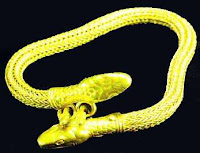
The Maykops produced an incredible trove of silver and gold items. Some of which you see here. They have also been called a possible first culture to use the wheel. That alone would make them a culture worth noting...

Show me, show me, Shulaveri-Shomu

There are going to be times when I simply can't get in what I'd like to on the podcast episodes because of time constraints. I'm trying to make sure the episodes don't last much longer than 30 minutes. Also, since I've for some strange reason decided to undertake the entire history of Europe in the podcast I'd like to get through it without spending episode after episode focusing on a single century or decade. Thus, important things will be left out. That's what the blog is for!!

The Neolithic podcast episodes (they'll be two of them) are set to come out May 10 and May 17, respectively. The scripts have been written and for time constraints I left out much of the Neolithic of the Caucuses. This isn't a slight to Europe's most eastern parts, its just that they developed more closely to the Middle East. I also left out Turkey's Neolithic cultures for that reason. But, because of their omission on the episode, I'm able to dedicate a good amount of time to a blog post. Loss turned gain for the Neolithic peoples of the Caucuses!

One of the earliest cultures in the Caucuses stretched out their legs in modern day Georgia, Azerbaijan and Armenia after walking into it from Mesopotamia. The Shulaveri-Shomu Culture had its origins in the Hassuna culture (as well as others) in Mesopotamia. The Hassuna Culture would eventually give rise to the Assyrians who are familiar to most people that have taken a world history course. This affinity to the Mesopotamian cultures meant that the Shulaveri-Shomu would adopt most of its characteristics from the Ancient Near East. They created mudbrick, circular homes (as you see pictured from a site in Georgia to the left) which were filled with tools made out of obsidian. They created anthropomorphic lady figurines that are associated with some type of fertility cult. Both obsidian working and fertility idols were common in the preceding Mesopotamian cultures.

The Shulaveri-Shomu culture lived at an interesting period in the earth's climatic history. The Holocene, which we mentioned on the Mesolithic podcast, marked the end of the Paleolithic and represented a rapid warming of the earth. But, the Holocene is an interglacial period, suggesting that the glaciers will some day return to drive man back into the equator regions. The Shulaveri-Shomu might have thought this was occurring. They lived during the boringly named 8.2 Kiloyear Event. But, its actions did not make for a boring time. In Mesopotamia and likely its northern neighbor the Caucuses, the result was a rapidly declining temperature and creation of arid soil for somewhere between 200-400 years. This happened to occur right at the start of the Shulaveri-Shomu period. But, they made it through and thrived for over 2,000 years from 6200 BC - 4000 BC before becoming overtaken by another culture we'll discuss soon enough, don't you worry!